The short version
HSE says: “Before assessing the risks, you need to understand the type of water system and its operation.” In a home that comes down to three questions. How is the water heated? Is any water stored, and where? Which outlets does each store feed? This lesson teaches you to answer them by looking.
Follow the water
Every home’s water makes the same journey, and a survey follows it in the same order:
- In. Water arrives from the street through the supply pipe and the internal stop tap.
- Stored or heated. Some of it is heated. In some homes some of it is stored first.
- Out. It leaves at the outlets: taps, showers, toilets, appliances, the outside tap.
- Away. It goes down the drain.
The stop tap
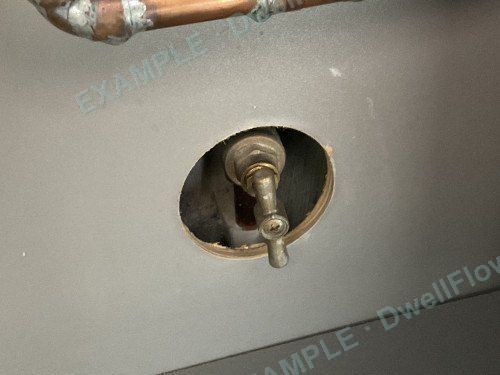
The internal stop tap, also called the stop valve or stopcock, shuts off the water to the whole property. Find it first. It tells you where the water comes in, and so where the journey starts.
Places to look: under the kitchen sink, in a ground-floor cupboard, in a utility room, under the stairs, in a garage, beside a downstairs toilet. In a flat it may be in a cupboard by the front door or in a service riser outside the flat. If you cannot find it, say so in the assessment. A landlord who cannot find the stop tap cannot shut the water off in a hurry, and that is a finding in its own right.
The three ways a home heats its water
Almost every home uses one of three arrangements. Which one you are looking at decides what the rest of the survey has to check.
1. A combi boiler
A combination boiler heats water at the moment it is used. Open a hot tap, the boiler fires, and water is heated as it passes through. Close the tap and it stops. Nothing is stored.
How to recognise it:
- One boiler, on a wall, in a kitchen, utility room, cupboard or loft.
- No hot water cylinder anywhere in the property.
- No cold water tank in the loft. (An old, disused tank may have been left behind. Lesson 4 covers that.)
- The boiler fires when you open a hot tap.
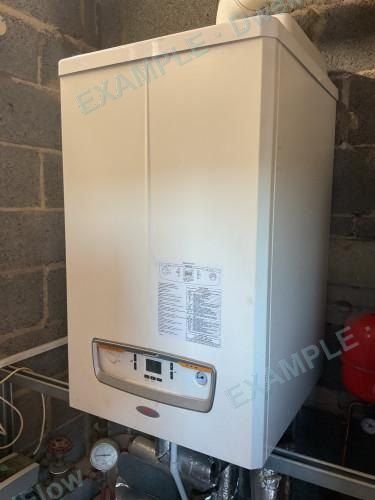
What it means for legionella. This is the lowest-risk arrangement. HSE says: “The risk is further lowered where instantaneous water heaters (for example combi boilers and electric showers) are installed because there is no water storage.” The risk that remains is in the pipes and at the outlets: taps and showers nobody uses, pipework left behind by old alterations, and dirty shower heads.
2. A vented cylinder with a cold water tank
The traditional arrangement, also called a gravity-fed system. A cold water storage tank sits high in the building, almost always in the loft. It fills from the mains through a float valve, like a toilet cistern. Water runs down from it by gravity into a hot water cylinder, where a boiler or an electric immersion heater heats it. A vent pipe rises from the top of the cylinder and bends over the tank.
How to recognise it:
- A tank in the loft: plastic in newer homes, galvanised steel or other materials in older ones.
- A copper or foam-covered cylinder, often in an airing cupboard.
- A pipe rising from the top of the cylinder and going up through the ceiling.
- Often a second, smaller tank beside the first. That one tops up the central heating. It feeds no taps.
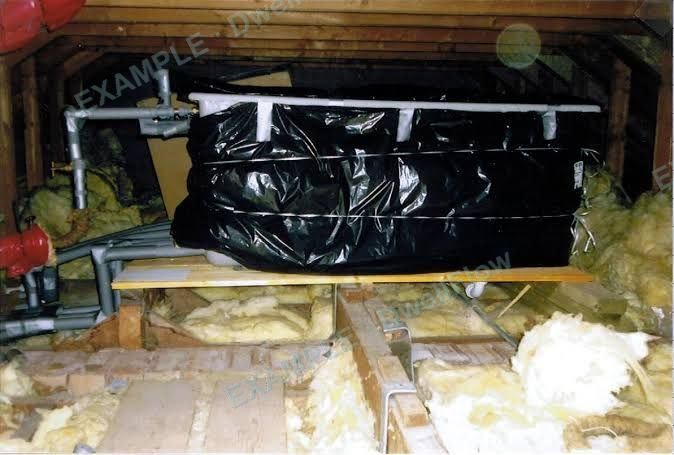
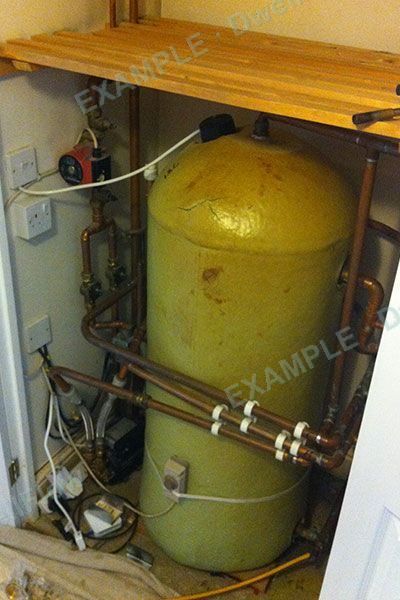
What it means for legionella. Water is stored in two places, and each has its own rule in HSE’s guidance:
- The cylinder should store hot water at 60 °C or above.
- The tank should keep cold water below 20 °C, and should be covered, clean and insulated.
This system needs the most attention of the three, because it has the most stored water and the most that can go wrong with it.
Stop and thinkYou find a combi boiler in the kitchen, and a tank still sitting in the loft. What should you ask yourself?Show the answer
Whether the tank is still connected. When a combi replaces an old system, the tank is often left behind. If it is still full and joined to the pipework, it holds water that never moves. Lesson 4 covers what to do about it.
3. An unvented cylinder
A modern stored system. The cylinder is fed straight from the mains and holds hot water at mains pressure. There is no tank in the loft. Hot water arrives at the taps with the same force as cold.
How to recognise it:
- A cylinder, usually in a white or grey steel case, with a maker’s label naming it as unvented.
- A small vessel beside or above it. This is the expansion vessel.
- Safety valves on or near the cylinder, with a discharge pipe running to a funnel-shaped fitting and on to a drain.
- No tank in the loft feeding it.
What it means for legionella. Hot water is stored, so the 60 °C rule applies. No cold water is stored, so every cold tap is on fresh mains water. The expansion vessel holds a small volume of water that barely moves. It should be included when the system is serviced.
Do not touch the safety valves. An unvented cylinder holds hot water under pressure. Its valves and its expansion vessel are for an engineer qualified to work on unvented systems. A survey looks and records. It does not adjust.
Other things that heat water
| What it is | What to know |
|---|---|
| Electric shower | A box on the wall with its own heater. HSE says these “pose less of a risk as they are generally cold water-fed and heat only small volumes of water during operation”. The head and hose still need cleaning. |
| Immersion heater | An electric element inside a cylinder. It may be the only heat source, or a back-up to the boiler. It has its own thermostat, under a cap on the cylinder. Electrical work is for an electrician. |
| Point-of-use water heater | A small heater under a sink or over a basin, serving one or two outlets. Some store a few litres. Record what it serves and whether it stores water. |
| Boiling water tap | A tap with a small heated reservoir under the worktop, often with a filter. The reservoir and the filter both need looking after to the maker’s instructions. |
Mains-fed or tank-fed: which taps are which
In a home with a loft tank, some cold taps are fed straight from the mains and some from the tank. The difference matters.
- Mains-fed water is fresh. It has come straight from the supply and has not stood anywhere in the house.
- Tank-fed water has stood in the tank first. It arrives warmer and less fresh, and it carries whatever the tank carries.
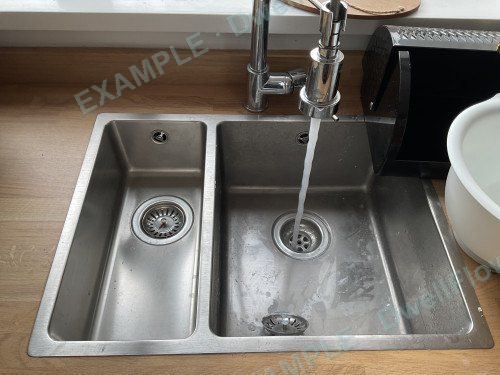
The kitchen cold tap should be on the mains, because that is the tap people drink from. A storage tank in a home is not built or looked after to the standard expected of drinking water. Bathroom cold taps in a gravity-fed home are very often on the tank.
Clues, not proof. A mains-fed tap generally runs with more force than a tank-fed one, and the difference is usually plain when you compare the kitchen tap with a bathroom tap. The only certain check is the plumber’s one: isolate the tank’s outlet and see which taps stop. If you cannot tell which supply a tap is on, record that you could not tell. Do not guess.
Stop and thinkThe kitchen cold tap runs hard. The bathroom cold tap upstairs runs gently. What might that tell you?Show the answer
That the two may be on different supplies: the kitchen on the mains and the bathroom on the tank in the loft. It is a clue and not proof. Record what you saw, and record whether you were able to confirm it.
Outlets that mix hot and cold
You will meet three kinds:
- Separate taps. One hot, one cold. Each gives you a true reading of its own supply.
- A mixer tap. One spout, two controls or one lever. Turned fully to hot it should deliver hot water only, but you cannot see inside it. Where there is a separate hot tap, use that for the reading.
- A thermostatic mixing valve. HSE: “these blend hot and cold water to reduce the temperature where there is a risk of scalding”. They are fitted inside thermostatic showers and sometimes on the pipes under a bath or basin. The water that comes out is blended by design, so it cannot tell you how hot the system is.
Lesson 5 explains how to take readings at each kind.
What each system means for the assessment
| System | What is stored | What the survey must check |
|---|---|---|
| Combi boiler | Nothing | Outlet temperatures, unused outlets, redundant pipework, shower heads |
| Unvented cylinder | Hot water | All of the above, and the stored hot water temperature |
| Vented cylinder and tank | Hot and cold water | All of the above, and the tank: its temperature, lid, insulation, cleanliness and which outlets it feeds |
Flats
A flat may have any of the three systems inside it. It may also take water from plant that serves the whole building: a shared tank, a booster pump, or a communal hot water system with a heat interface unit in each flat. If the water is stored communally, its temperature and condition on arrival are set by equipment you cannot see from inside the flat. Record what you find inside, and ask the freeholder or managing agent about the rest. Lesson 2 covers who is responsible.